You’re staring at a $9,000 build sheet, and the real question is golf simulator resale value: what do you get back if this doesn’t work out? Every retention percentage online, from 55 to 75 percent, comes from a site with a new unit to sell, no sample, no date.
By the end, you’ll know what your model sold for this year, what it costs a buyer to take it off your hands, and which parts of your bay are worth nothing. Check the Indoor Golf Simulator Lab roundup if you haven’t picked hardware yet.
Golf Simulator Resale Value
Golf simulator resale value is what a buyer pays you after the manufacturer’s ownership transfer fee, deregistration, and non-transferable software licenses take their cut. Only the launch monitor holds secondhand demand. Screens, mats, and projectors depreciate like ordinary electronics. Buy the model the market already prices honestly, and the exit costs less.What Resale Value Really Means for a Simulator
Resale value splits into four separate numbers, not one: what a buyer pays for the hardware, what the manufacturer charges to transfer it, what software survives the sale, and what your screen and mat are worth after a few thousand swings. Quote a single percentage and you’ve already left out three of the four.
What does golf simulator resale value actually mean here?
Think of it the way you’d think about a car dealership that charges the new owner a fee just to change the title. That’s not a hypothetical. It’s how Foresight, Uneekor, and TrackMan handle every used unit that changes hands.
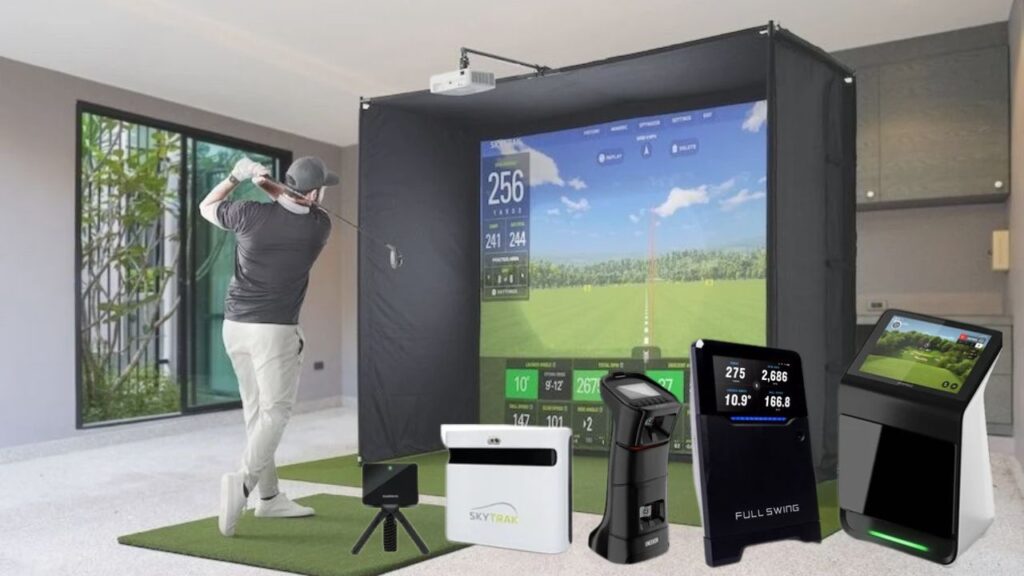
A manufacturer’s ownership transfer fee is the charge a brand bills the second owner to register a used device and activate full support. Most published resale percentages pretend this fee doesn’t exist. It does, it can run into four figures on a premium unit, and the buyer pays it after the sale, which is exactly why it needs to be priced into the negotiation up front.
Your bay is four assets, not one machine
Name the four buckets before you quote a single percentage, because only one of them has buyers actively shopping for it.
| Asset | Resale reality |
|---|---|
| Launch monitor | Active secondhand market, model-specific pricing, transfer fee applies |
| Enclosure and screen | Local pickup only, freight kills the math, fabric wear caps the price |
| Mat and turf | Almost no resale value once broken in |
| Projector and PC | Standard electronics depreciation, no simulator premium |
Your money is sitting in one of those four rows right now. Which one?
The launch monitor is the only liquid piece
The launch monitor is the one component with real buyers waiting, because cameras and radar units have no moving parts, so age hurts them less than actual use does. Buyers shop by model name on eBay and Golf Simulator Forum, not by the story of your build, which is why a bare launch monitor moves in days while a full custom package sells slowly.
Want an honest exit strategy? The exit is the monitor. Everything bolted around it is closer to furniture than investment.
What Used Launch Monitors Actually Sold For
Completed eBay sales beat every retention percentage published online, because a sold listing is a real transaction with a date attached, not a marketing claim. A sample pulled August 25, 2026, from 428 completed listings gives you actual numbers instead of a guess.
Real sold prices beat every retention percentage online
Golf Sim Spot’s sold-listing data from that window shows a wide spread by model, not a flat industry rate:
- Garmin Approach R10: median around $325, in a tight $299 to $365 band
- SkyTrak+: median around $1,076
- Bushnell Launch Pro: median around $1,625
- Foresight GC3, built by Foresight Sports (acquired by Vista Outdoor in 2021 and now part of the Revelyst Precision Sports Technology platform alongside Bushnell Golf): median around $3,525
- Full Swing KIT: median $1,850 against a $4,999 list price, the steepest drop in the sample
Compare those medians against what these builds cost new and the real depreciation gap shows up fast. It’s nowhere near the same shape for every model.
Retention swings wildly between models, not brands
A model, not a badge, decides what you get back, with savings running roughly 30 to 63 percent below new depending on the specific unit. A brand that “holds value” in one product line can still own the worst-performing model on this entire list.
Price the exact model you’re selling or buying. Never price the logo on the front.
Sample size matters more than the median you read
A median built on four sales is a hint. A median built on twenty-three sales is a market. SkyTrak+ had only four completed sales in that 60-day window, while Bushnell Launch Pro had 23, which is exactly why its price band deserves more trust than a headline number suggests.
Any honest write-up publishes the sample count beside the price, not just the number.
Where the published percentages come from, and why they conflict
Retention claims from 55 to 75 percent show up across five different affiliate sites, and not one shows a method, a sample, or a date. Retailers selling new units have no reason to publish depreciation figures that undercut their own sales floor.
Prices move month to month, so re-run the sold-listing search before trusting any number more than a few months old.
The Transfer Fee That Eats Your Sale Price
The transfer fee is the line no retailer product page mentions, and it lands on the buyer after the sale, which means it lands on your asking price before the buyer ever agrees to pay it. Across the major brands it runs from $100 to $1,000, and the amount depends entirely on which unit you’re moving.
Foresight charges $500 to $1,000 to change your name
Foresight’s device ownership transfer fee, published in its help center article on transferring ownership and updated December 17, 2025, actually runs on a sliding scale rather than one flat number:
- Launch Pro and Launch Pro Indoor: $250
- GC3 and GC3s: $500
- GCQuad, QuadMax, Falcon, and GCHawk: $1,000
The fee gets waived for a buyer who already owns a registered Foresight unit, worth mentioning in your listing. FSX Play, FSX Pro, and FSX 2020 software licenses don’t transfer at all, no matter what the buyer pays.
TrackMan will not publish its transfer fee at all
TrackMan confirms that both hardware and software licenses need to transfer, but the dollar amount stays off its site entirely, and support only says they’ll inform you once you ask.
Third-party estimates on forums conflict badly, landing anywhere from roughly $500 to $1,000, so treat any number outside TrackMan’s own support channel as unverified. Buying a used TrackMan 4? Get the fee in writing before you agree on price.
How sellers on Golf Simulator Forum price the fee in
Experienced private sellers disclose the transfer fee inside the listing itself, because buyers walk the moment a surprise charge shows up after they’ve already committed. One broker claims a flat $199 Foresight fee, while Foresight’s own published page puts the real range between $250 and $1,000 depending on the model. Screenshot the manufacturer’s page before you list or buy. Never take a reseller’s word for what a brand actually charges.
Uneekor runs the cleanest version of this math. Its terms and conditions set a flat $100 per-device license transfer fee, plus $50 for every additional feature add-on the buyer wants active.
Software and Warranty Die With the First Owner
Software and warranty coverage mostly don’t survive a change of ownership, so a used unit’s price should reflect exactly what the second owner is actually buying. Hardware transfers. Almost nothing else does.
Your warranty ends with you, and buyers know it
SkyTrak’s published Consumer Limited Warranty names the original consumer only and states plainly that it doesn’t transfer to a second owner. Foresight’s terms of sale run the same way. Self-insuring a $3,500 used unit means budgeting for a full repair out of your own pocket the day something fails. That’s a real cost, so price it into the deal.
That $250 GSPro year is not part of the sale
Software transferability splits sharply by platform, and pretending otherwise costs the seller money at closing:
| Software | Transfers with hardware sale |
|---|---|
| GSPro | No, subscription tied to buyer’s own account |
| TGC 2019 | No, ProTee United stopped processing transfers January 1, 2025 |
| FSX Play / FSX Pro / FSX 2020 | No, Foresight terms bar transfer |
| E6 Connect | Check current license terms before listing |
| Awesome Golf | Check current license terms before listing |
GSPro runs on a subscription tied to an email address, so price it at zero in any listing. That $250 annual license isn’t part of what you’re selling.
Buyers who find a unit still on your account
One eBay buyer powered up a used SkyTrak+ and found it still registered to the previous owner’s account, a pattern that shows up often enough on resale forums to matter.
Deregister the device before the box ships, not after the money clears. A unit still tied to someone else’s account reads as stolen to a nervous buyer, and that single step protects your price more than any cleaning or photography ever will.
Screens, Mats and Projectors Are Not Assets
Screens, mats, and projectors are worth close to nothing the day after delivery, and pretending they hold value is how sellers overprice a listing and watch it sit for months. Name this now, before you build your asking price.
Soft goods wear, and wear does not resell
An impact screen absorbs thousands of strikes and wears the way a heavy bag does, fraying at the grommet line and losing tension after a couple of winters. A worn hitting strip changes how the mat feels at contact, and a buyer who’s hit a fresh mat notices in the first swing.
Projectors and PCs follow ordinary electronics decline, nothing golf-specific. None of that is a defect, just use, and used soft goods don’t have a resale market worth mentioning.
Frames and enclosures are the quiet exception
Aluminum tube frames and connectors are hard to damage and cheap to find used, which makes them the one soft-goods category worth listing separately from the launch monitor. Freight costs push most sellers toward local pickup only, since shipping a ten-foot frame costs more than the frame is worth.
That’s where a buyer wins and a seller loses. Local pickup on a frame is basically a discount nobody advertises out loud.
The Successor Launch Is the Real Repricing Event
A used unit’s value doesn’t fade gradually, it steps down in one move the day a manufacturer announces the next model. Depreciation on this gear looks like a cliff, not a slope.
Your unit drops the day the next one ships
FlightScope’s own trade-in program shows the pattern: a Mevo+ earns a $250 credit toward the $1,299 Mevo Gen2, netting $1,049, plus $50 to transfer the Face Impact Location license, $100 for the Pro Package, or $150 for both.
Used Mevo+ medians now sit close to that new Mevo Gen2 list price, proof of how fast the older unit repriced once the newer one existed.
Uneekor’s EYE XO tells the same story at a much higher price point, trading well below the EYE XO2’s $10,999 list price. That overnight step-down is exactly what shows up in luxury bay depreciation once a five-figure unit gets replaced by its successor.
Watch the trade in page for the warning sign
A manufacturer opening a trade-in program is the clearest signal a successor model is close, and SkyTrak’s own ST MAX trade-in program for ST+ owners fits that pattern exactly. SkyTrak now states outright that it’s not offering trade-in credit for original SkyTrak units anymore. Getting dropped from a trade-in list isn’t a technicality, it’s the manufacturer telling you that model is finished.
Two models trading used above a newer unit’s price
Original SkyTrak units have traded used around $445, while the maker’s own outlet sold refurbished units for $499, a gap of roughly 10 percent for zero warranty coverage. Paying nearly the same price as a covered refurbished unit for an uncovered used one isn’t a deal, it’s a mistake dressed up as a bargain. Wait out a repricing event when the numbers sit this close.
Your Three Exit Routes and What Each Pays
Three routes exist to sell a simulator, and each one trades speed against payout in a different direction.
| Route | Payout | Speed | Effort |
|---|---|---|---|
| Private sale | Highest | Slowest, weeks to months | You handle fraud, packing, and calibration questions |
| Dealer cash offer | Lowest, published as a floor | Fast, often same week | Minimal, one transaction |
| Manufacturer trade in | Store credit only, no cash | Fast, days | Minimal, but credit-restricted |
Private sale pays most and costs you the most time
A private sale pays the most because you’re removing the dealer’s margin entirely, and a listing with a video of the unit actually running sells faster and for more than static photos alone. You carry the fraud risk, the packing risk, and every calibration question a nervous buyer asks before wiring money.
Launch monitors move fastest on Golf Simulator Forum and eBay, while full enclosures move locally through pickup-only listings. Listing your simulator for sale walks through how to price and post it the right way.
Dealer cash offers are the floor, and they are public
Dealer cash offers set the honest floor for what your unit is worth, since brokers publish the ranges they’ll pay for units like the GCQuad, GC3, TrackMan 4, and TrackMan iO right on their own sites.
Those ranges run wide, because condition, edition, and included accessories all move the number. Treat a published broker range as a starting point, not a quote, and confirm the real number with a live offer.
Manufacturer trade in is store credit, not money
SkyTrak’s published trade-in program shows exactly what “trade in” pays: an ST+ purchased under 90 days ago earns $1,000 in credit, over 90 days earns $750, and no proof of purchase earns $500.
None of it comes as cash, and the credit only applies toward an ST MAX or ST MAX Studio purchase, roughly what the unit sells for used anyway, minus the freedom to spend it elsewhere.
What forum sellers say about trade in offers
Owners on Golf Simulator Forum routinely describe a $500 trade-in offer on a fully working unit as insulting, and it’s easy to see why next to a private sale. The counterargument still holds weight: credit arrives in days, while a private sale can drag on for months. Which one can your patience actually afford?
Does the Room Itself Add Anything to Your House
A dedicated simulator room adds close to nothing to your home’s appraised value, unless you happen to find the rare buyer who golfs. That’s a very different answer from what most vendor pages claim.
An appraiser and realtor answered this on the forums
A licensed realtor and appraiser with three decades of experience answered this bluntly on a homeowner forum: unless you land a buyer who specifically golfs, added value sits close to zero, and a dedicated sim room can even shrink your buyer pool once it needs retrofitting back into living space.
The comparison used was a swimming pool, something a subset of buyers love and a subset actively avoids. Build the room for yourself, not for a future sale.
Build it so it converts back to a bedroom
Framing the room to double as a legal bedroom protects its resale value far better than a dedicated golf space ever will, which means egress window size, insulation, working smoke alarms, and a closet all need to meet code from day one.
Room conversion requirements come from local building and fire code, so verify the exact standard with your municipality first. Modular builds, like a freestanding net and screen instead of a fixed enclosure, travel with you when you move. A bolted-in room doesn’t.
Why vendors keep telling you otherwise
Installer pages and luxury build sites lean hard on buyer appeal because that’s the story that sells installations, and not one of them cites an actual appraisal, a comparable sale, or a real dollar figure. Ask any installer making that pitch for the comparable sale they’re basing it on. If they can’t produce one, you already have your answer.
How to Buy So Leaving Costs Less
Six decisions made at the moment of purchase quietly set your exit price years later, long before you’re thinking about selling anything.
Buy the model the market already priced honestly
A narrow sold-price range on a model means a settled market with predictable resale, while a wide, scattered range means nobody’s sure what the thing is worth yet. Buying the month before a successor model ships is the single most expensive timing mistake on this list. Favor models the manufacturer still actively sells and supports with software updates.
Register software to an account you can hand over
Keep the original box, serial number, charger, and receipt from day one, because a complete paper trail is what makes a buyer trust your price without a discount for uncertainty.
Some owners set up a dedicated email address purely for simulator software licenses, which keeps the handful of transferable licenses actually movable at sale time. Deregister the device, photograph the serial number, and record a short video of it hitting balls before you list it.
Conclusion
You arrived believing your simulator would hold value like a launch monitor holds its shot data: precisely. It doesn’t. The monitor is the one real asset, the transfer fee is the buyer’s problem until it becomes your discount, and the room itself owes you nothing at resale. Tonight, search your exact model on eBay with the sold-items filter turned on, and write down the three most recent prices with their dates.
This build pays you back in rounds played, not resale checks cashed, and pricing it that way from day one is the only honest way to buy one.
Frequently Asked Questions
Do golf simulators hold their value?
No, not the way published retention percentages claim. Real sold-listing data shows savings of 30 to 63 percent below new depending on the model, and only the launch monitor holds real secondhand demand.
Do golf simulator warranties transfer to the second owner?
No, the major brands write their limited warranties for the original consumer only. SkyTrak and Foresight both state this directly, so buying used means self-insuring against any hardware failure.
Do software subscriptions and course licenses transfer with the hardware?
Mostly no. GSPro runs on a subscription tied to the buyer’s own account, TGC 2019 transfers stopped processing on January 1, 2025, and Foresight’s FSX licenses are explicitly non-transferable.
Should I wait to sell before the successor model launches?
No, sell before the announcement, not after. Value steps down the day a manufacturer ships the next model, so a new trade-in program on your model is the clearest sign to list now.
Does a home golf simulator room add resale value to the house?
No, not unless you find a buyer who specifically golfs. A licensed appraiser compared it to a swimming pool on a homeowner forum: some buyers love it, many avoid it, and added value sits close to zero either way.