Trackman indoor golf simulator cost starts at $13,995, and that’s the number stuck in your head. Then a retailer quotes $34,000 for the same room and you stop returning calls. That gap exists because $13,995 buys a ceiling sensor, not club data, a screen, or the PC that runs it.
By the end of this, you’ll have your own line-by-line number, built from your ceiling and room depth, not a brochure, plus the best indoor golf simulator setups that hit real numbers for thousands less.
Trackman Indoor Golf Simulator Cost
Trackman indoor golf simulator cost runs from $13,995 for a bare iO to roughly $56,240 for a fully built Trackman 4 room over five years. The sensor is the smallest decision here. Ceiling height, room depth, software tier, and PC spec set the real price for every buyer.Start With The Number Trackman Never Publishes
Trackman never publishes one price for a finished room, because the $13,995 figure only covers the sensor itself.
So what is the real trackman indoor golf simulator cost?
The real trackman indoor golf simulator cost sits closer to $29,715 for a complete package, not $13,995. Trackman’s own site lists the iO from $13,995 and complete packages from $29,715. Independent build shops quote finished iO rooms between $25,000 and $35,000, and Trackman 4 rooms land north of $35,000. That gap is the whole reason this guide exists.
Why the headline price is only the entry ticket
The $13,995 headline buys a ceiling-mounted sensor and nothing you swing at, watch, or stand on. One golfer in a build forum budgeted exactly that number, then found he still needed a PC, a screen, and a mat before hitting a ball. Trackman includes year one of software with purchase, so year two is the first surprise on the statement.
The three numbers you should write down tonight
Ceiling height, tee-to-screen depth, and room width decide your budget before you shop. Measure ceiling from the finished hitting surface, not the bare slab underneath, since a thick mat eats inches you counted on. Trackman iO minimum ceiling height is the first number every retailer asks for, and getting it wrong means finding out after the mount holes are drilled.
Trackman iO Versus Trackman 4 For Indoor Rooms
The Trackman iO beats the Trackman 4 for most indoor rooms, built for permanent indoor mounting at a lower price.
| Factor | Trackman iO | Trackman 4 |
|---|---|---|
| Starting price | $13,995 | ~$25,495 |
| Mounting | Ceiling-mounted, indoor only | Floor-mounted, portable |
| Room depth needed | No minimum in front of or behind the ball | Roughly 16 to 20 feet behind the golfer |
| Outdoor use | No | Yes, full ball flight |
| Dual dexterity | Duo model adds about $3,500 | Repositioned per player |
Why the cheaper unit is usually the better indoor buy
The iO is usually the better indoor buy because Trackman built it for permanent rooms, not as a scaled-down outdoor unit, starting at $13,995 against $25,495 for the Trackman 4 at Carl’s Place, an $11,500 gap before any other component.
Optically Enhanced Radar Tracking, or OERT, is Trackman’s term for radar plus camera imaging measuring impact together, letting the iO sit close to the ball with no minimum distance requirement in front of or behind it.
What you give up when you skip the Trackman 4
Skipping the Trackman 4 costs you attack angle, the one real data gap the iO can’t close, the kind of detail covered under pro-grade simulator specifications. Fitters care about that number; most weekend players won’t. The 4 also works outdoors to full ball flight, while the iO stays permanently mounted and indoor only.
The iO Duo tax for narrow rooms
The iO Duo tax runs about $3,500 over a single unit, letting a right and left-handed golfer share one bay without moving the mount. Retailers list the iO Duo at roughly $17,495 for the Home tier, against $13,995 single. Add a narrow room and a left-handed kid to the house, and that $3,500 stops being optional.
Why does a second iO cost less than club data?
A second iO costs less than the club data upgrade because Trackman prices the ecosystem, not the sensor. GolfWRX posters note a second unit runs about $3,500, while unlocking full club data through Home Complete adds far more to the hardware price. You’re paying for tour-validated ball and club models.
The Subscription That Unlocks Your Club Data
The subscription that unlocks full club data is Home Complete at roughly $1,100 a year, not the $700 base tier most buyers assume covers everything.
What $700 a year actually gets you
The $700-a-year Home tier gets you ball data plus club speed and smash factor, enough to see distance and shot shape on screen. Smash factor is ball speed divided by club head speed, a measure of strike efficiency. Course access here caps at roughly 60 courses, plenty for playing rounds, thin if you bought Trackman to fix your swing.
What another $400 a year buys back
Another $400, bringing the total to roughly $1,100 under Trackman’s published subscription tiers, buys back face angle, dynamic loft, and impact offset, plus a jump to hundreds of courses rendered in Virtual Golf 3, Trackman’s course software. The sensor upgrade to unlock that data runs several thousand dollars more, a fact most buyers never see coming.
What happens the year you stop paying
The year you stop paying, advanced features switch off but ball speed and smash factor keep working. Budget the subscription as rent, and multiply it by five years before comparing Trackman against a unit with no subscription at all.
Your Room Sets The Price Before You Shop
Your room sets the Trackman price before you shop, since ceiling height and depth decide which unit you’re even allowed to buy.
The 9 foot 4 inch ceiling line that decides everything
9 feet 4 inches is the minimum ceiling height Trackman’s help center lists for an iO bay, measured from the finished hitting surface, with 9 feet 8 inches as the ideal mounting height. Mat thickness steals real ceiling space too, and a thick stance platform can knock a room that measured fine on paper out of contention.
Why 16 feet of depth changes your whole budget
16 to 20 feet of total depth is what the Trackman 4 wants behind the golfer, and coming up short forces a compromise felt every session. Spin axis is the tilt of the ball’s rotation that produces a draw or a fade, one of the numbers a cramped room distorts. A short room paired with a 4 means paying more for worse numbers than the iO gives in that same space.
The width number that forces the Duo upgrade
15 feet of width is what retailers recommend for comfortable dual-dexterity play, and anything under roughly 12 to 14 feet pushes toward the Duo upgrade. Trackman’s published minimum tee-to-screen distance is 8 feet 2 inches, with 10 feet recommended for safety. A 10-foot garage bay with a left-handed spouse is exactly the scenario Duo pricing exists to solve.
Screen, Enclosure, Mat, And Projector Line Items
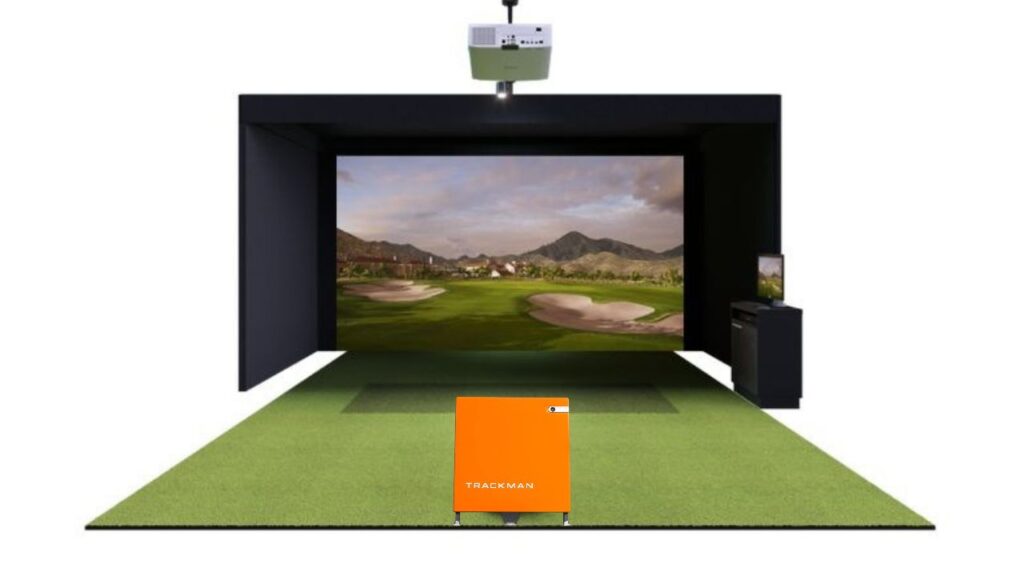
Screen, enclosure, mat, and projector line items add anywhere from $2,000 for a DIY kit to well over $10,000 for a prebuilt bay.
| Component | Budget option | Premium option | What the difference buys |
|---|---|---|---|
| Screen and frame | DIY kit, $800 to $1,500 | Prebuilt bay, high $3,000s | Tension and durability, no image ripple |
| Projector | Short throw 1080p, about $700 | Laser 5,100 lumen, about $5,000 | Brightness and a shadow-free image |
| Hitting mat | Thin foam | Shock-absorbing platform | Joint comfort over hundreds of swings |
| Enclosure | Basic frame | Custom sized to the inch | Fits rooms nothing else fits |
What a screen and enclosure really cost installed
A screen and enclosure installed runs from about $800 for a DIY kit to the high $3,000s for a prebuilt bay from a major retailer. Custom enclosures cost more but fit oddly shaped rooms nothing else will. Trackman’s own iO setup guide asks for a hitting surface at least 6 feet deep by 5 feet wide.
Why short throw is not optional in most rooms
Short throw is not optional in most Trackman rooms, since a standard projector needs distance most garages don’t have. Throw ratio is how far a projector sits from the screen per foot of image width, like how far a flashlight sits from a wall to light it evenly.
Standard throw projectors put your own shadow across the green, so short throw units run about $700 for 1080p to nearly $5,000 for a 5,100 lumen laser.
The mat you buy twice if you cheap out
A cheap hitting mat is the one you buy twice, since thin foam sends shock straight into your lead wrist and elbow within a single session. Trackman’s iO tracking also wants a level, green hitting surface, so the mat affects data quality, not just your joints.
The PC Requirement That Ambushes Budgets Late
The PC requirement ambushes most budgets late, because Trackman Performance Studio needs specific hardware most home computers, gaming rigs included, don’t meet.
Intel only, and why your Ryzen build is dead
Intel only is the rule, and it means an existing Ryzen gaming PC is dead on arrival for this build. Trackman Performance Studio requires an Intel Core i7 or Core Ultra 7 processor and does not support AMD processors, AMD GPUs, or ARM chips. Ask before signing anything.
The GPU line that adds four figures
The GPU line adds four figures: Trackman’s published minimum is an RTX 4070 Ti-class card for HD play and an RTX 4080 or better for 4K, with a 32GB RAM floor that rules out most computers people already own. Performance Studio also wants Windows 11 64-bit and dual gigabit Ethernet.
Where to buy the machine without overpaying
Buy the machine direct from a component seller, since bundled simulator PCs almost always cost more than the same parts bought separately. Verify the exact processor and card against Trackman’s published spec first; an underpowered machine stutters through Performance Studio.
Install, Power, And Construction Costs Nobody Quotes
Install, power, and construction costs nobody quotes can add thousands once the equipment arrives.
Ceiling backing, mounts, and why installers charge what they do
Ceiling backing explains why installers charge what they do: the iO is VESA compatible, but somebody still has to build proper backing behind the ceiling to hold it. Trackman notes recessed ceilings need at least a third of the screen visible to the front camera, which can force the mount, and your tee position, elsewhere.
Power, climate, and the noise your family will hear
Power, climate, and noise never show up on a spec sheet. Have a licensed electrician confirm your circuit against local code before running a projector, PC, and launch monitor off one outlet, and plan for ball strike noise, which travels through floor joists more than most expect.
The DIY line you should not cross
The DIY line you shouldn’t cross is mount alignment and calibration, even though screen tension and frame assembly are reasonable weekend work. Reviewers who install their own screens still hire a pro for the overhead sensor work, where DIY builds quietly lose data accuracy.
Add It Up: Three Honest Trackman Budgets
Three honest Trackman budgets land at roughly $22,000, $30,000, and $56,000, depending on the room, the software tier, and how much you build yourself.
| Build | Unit | Software | Room | Total |
|---|---|---|---|---|
| Lean iO basement | iO Home, $13,995 | Home, $700/yr | DIY enclosure, mid short throw | Low $20,000s |
| Full comfort iO room | iO Home Complete, $21,495 | Complete, $1,100/yr | Prebuilt bay, laser projector | $25,000 to $35,000 |
| Trackman 4 garage | Trackman 4, about $25,495 | Complete, $1,100/yr | Full enclosure, insulation, install | $35,000 and up |
The lean iO build in a finished basement
The lean iO build in a finished basement lands in the low $20,000s, pairing the base iO with the $700-a-year Home subscription, a DIY enclosure, a mid-tier short throw projector, and a PC that just clears spec. The compromise is the software tier and the club data it withholds, not the hardware.
The full comfort iO room most buyers land in
The full comfort iO room most buyers land in runs $25,000 to $35,000, matching what Trackman quotes for a complete package: Home Complete, a prebuilt bay, a laser projector, and professional install. It’s worth checking against other indoor golf simulator cost guides before committing to one ecosystem.
The Trackman 4 garage build with real depth
The Trackman 4 garage build with real depth starts around $25,495 for the unit alone and climbs past $35,000 once enclosure, projector, PC, and install get added. You’re buying outdoor capability here, the kind of setup covered under high-end room builds, so be honest about whether you’ll use it.
Five Year Ownership Cost, Not Purchase Price
Five year ownership cost, not the purchase price, decides whether Trackman is worth it, since the subscription and repair exposure keep running long after the invoice is paid.
What total cost of ownership means for a simulator
Total cost of ownership means the purchase price plus every recurring cost across your ownership window, not just the first receipt. Add five subscription renewals, then factor in the finite life of screens, mats, and projector lamps.
The Trackman number versus the camera based alternatives
The Trackman number over five years can run to roughly $56,240 for a fully built Trackman 4 room with Home Complete, while several camera-based rivals carry no annual subscription at all.
| Five year line item | Cost |
|---|---|
| Trackman 4 launch monitor | $25,495 |
| Home Complete, years 2 through 5 | $4,400 |
| Enclosure, screen, turf, and mat | $13,750 |
| Laser short throw projector | $4,995 |
| Compliant PC | $3,500 |
| Professional install | $3,000 |
| Design and shipping fees | $1,100 |
| Five year total | $56,240 |
That gap against a no-subscription rival runs into the thousands, though Trackman keeps updating units bought years ago, so you’re not buying static hardware.
How many bay hours and range buckets it replaces
How many bay hours and range buckets your Trackman replaces depends on how often you actually play, so divide your all-in number by realistic sessions per week, not aspirational ones.
Commercial Trackman bays charge premium hourly rates, a fair comparison price, and playing twice a week for five years makes the math far easier to defend.
Buying Used, Resale, And The Transfer Fee
Buying used, resale, and the transfer fee all come with a catch: Trackman’s own help center says licenses don’t move with the hardware automatically.
What the used seller forgot to mention about licenses
What the used seller forgot to mention is that Trackman ties both software and hardware licenses to the original owner, not the unit. Sellers on golf forums routinely quote a four-figure transfer fee after the sale is agreed, so add that fee plus a fresh subscription to any used asking price.
What used Trackman 4 units actually sell for
Used Trackman 4 units sell for roughly $12,400 to $19,000 on golf forum classifieds, with indoor-only units going for less than dual indoor-outdoor licenses. Ask for the serial number before sending money, then verify license status directly with Trackman.
What your iO is worth in three years
What your iO is worth in three years is less than you’d hope, since permanently installed, ceiling-mounted hardware attracts a narrower buyer pool than a portable unit. Resale is real, just slower than expected.
Conclusion
You arrived thinking Trackman cost $13,995. You’re leaving knowing your ceiling height, room depth, software tier, and PC spec set the real number, and that you can build that budget yourself instead of trusting a retailer’s quote.
Tonight, measure your ceiling height from the finished hitting surface and your tee-to-screen depth, then write both numbers down before talking to anyone selling equipment. A range membership disappears every January. A room that gives you real numbers in February pays you back every winter you own it.
Frequently Asked Questions
How much does a Trackman indoor golf simulator cost all in?
A real Trackman room runs from about $22,000 for a lean iO basement build to roughly $56,000 over five years for a fully built Trackman 4 room with Home Complete. The $13,995 you’ve seen quoted only covers the launch monitor.
What does the $13,995 Trackman price actually include?
The $13,995 price includes only the Trackman iO launch monitor and its first year of software, not a screen, enclosure, projector, mat, or the PC needed to run Performance Studio.
Do I have to pay the Trackman subscription every year?
Yes, and skipping a year turns off club data and the full course library, though ball data and smash factor keep working. Budget it as rent on the room, not an optional extra.
Can I run GSPro on a Trackman?
No, Trackman doesn’t support GSPro, E6 CONNECT, or TGC 2019, so third-party course libraries stay off the table regardless of spend. Look at an open-ecosystem launch monitor instead, like a Foresight Sports GC3 or Uneekor EYE XO2 setup, when community courses matter to you.