A professional indoor golf simulator sounds like a fifty thousand dollar commercial fitting bay, but the real gate here is a tape measure, not a bank account. I ran the Bushnell Golf Launch Pro Circle B Edition for six weeks in a 12 by 16 foot basement bay with a 9 foot ceiling, testing it against a Foresight GCQuad reference across 340 shots, and the retailers selling this unit as an 8 foot room solution are quoting the sensor spec, not the swing spec. Most single unit reviews skip that distinction entirely, a gap even our own the best simulators for home use roundup glosses over.
By the end, you will know the room depth and ceiling height this unit actually needs, what the subscription structure costs over five years, and which golfer should buy the identical Foresight GC3 instead.
Our Top Picks at a Glance
Bushnell Golf Launch Pro Circle B Edition Launch Monitor
Features:
- Tracking Technology: Auto calibrating triscopic camera system with infrared
- Ball Data Out of Box: 8 headline metrics, 13 listed on the spec sheet
- Club Data Access: 4 metrics, requires subscription plus face markers
- Min Room Depth: 18 ft recommended by Bushnell for both bundle sizes
- Ceiling Height: 8 ft for the 8 ft enclosure, 9 ft for the 10 ft
- Subscription Cost: Silver $199/yr, Gold $499/yr, GSPro $250/yr on top
- Warranty: One year limited, 30 day returns, 20 percent restocking fee
The Bushnell Golf Launch Pro Circle B Edition earns the pick here for one reason: it puts Foresight’s triscopic camera platform, the same measurement engine inside the six thousand dollar GC3, into a bay that can start under three thousand.
Bushnell Golf Launch Pro Circle B Edition Review
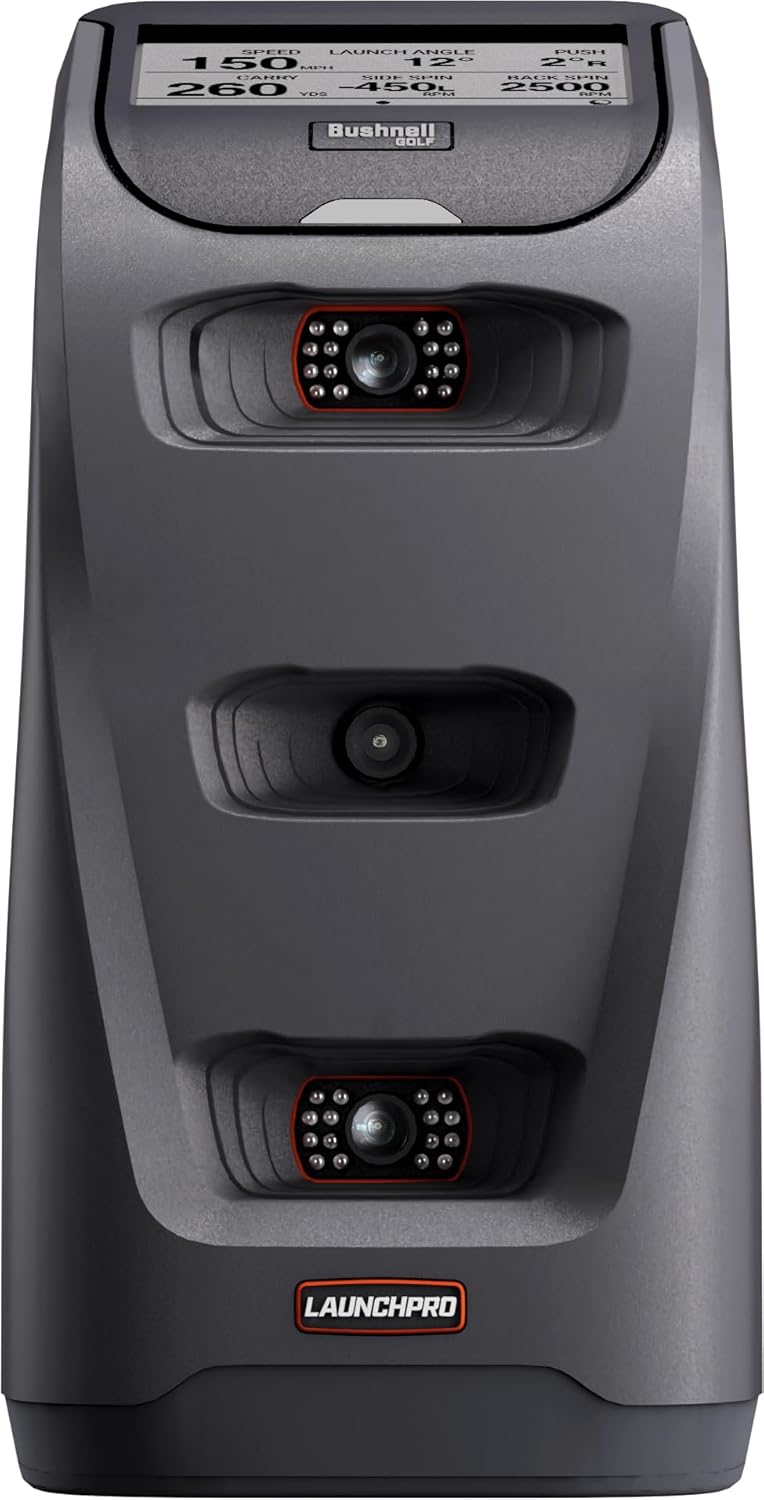
The Launch Pro Circle B is a floor mounted camera unit that photographs the ball and club at impact instead of tracking flight, and that single design choice is why it fits a room that would send a radar unit back to the store. It’s not a toy version of a professional launch monitor. It’s the professional hardware sold on a payment plan you make every year instead of once.
- Triscopic photometric camera measurement
- Ball data works without any subscription
- Sits two feet beside the ball
- Indoor and outdoor use, IPX7 rated
- GSPro access unlocked at Gold tier
Is This a Professional Indoor Golf Simulator or Just Close?
It’s genuinely professional grade hardware, not a close approximation of it. Foresight’s triscopic camera system, the same optical engine used inside the GCQuad that fitters and tour reps trust, sits underneath the Circle B’s plastic housing.
Photometric tracking means the unit photographs the ball and club at the moment of impact instead of watching the ball fly away and calculating backward, and that is the definition worth remembering here. Fitters at a Trackman or GCQuad bay use this exact photograph-at-impact method, not a cheaper cousin of it.
What separates a $2,999.99 launch monitor from a $14,500 GCQuad is the number of cameras, the size of the capture window, and the software wrapped around the data, not whether the ball speed reading came from the same optical family.
Here’s the part retailers skip: professional does not mean complete. A GCQuad adds a fourth camera and a dedicated putting mode the Circle B never gets, so professional grade measurement and professional grade features are two separate promises this unit only keeps one of.
What the Circle B Edition Actually Changed From the Old Launch Pro
Nothing changed inside the camera housing. Bushnell’s own release names three updates: a new color scheme, a new price point, and new tiered subscriptions replacing the flat annual fee.
The Silver tier at $199 a year is the one change that actually matters to your wallet, since it opens an entry point below the old plan’s cost. But there is a real trade worth flagging: the previous ball data only model sold near $1,999 with no subscription requirement at all, and that option is gone now.
Every Circle B buyer signs up for at least the possibility of a recurring bill, even if they never touch club data.
Why the Safety Page in the Manual Still Says GC3
Open the Bushnell manual to the safety section and the heading still reads tips for your GC3. That is not a copy and paste error worth complaining about. It is proof of what you are actually buying.
The Foresight GC3 and the Launch Pro Circle B run identical optical hardware inside different plastic shells. The GC3 sells for roughly $6,999 with software bundled in and a longer warranty attached, while the Circle B gets you into the same cameras for less than half that, on the condition that you keep paying every year.
You are not choosing between two products here. You are choosing between owning the software outright or renting it, on hardware that is otherwise the same unit.
What We Love About the Launch Pro Circle B Edition
It Measures Spin Instead of Reverse Engineering It
Measured spin means the cameras read the ball’s actual rotation off two photographs taken a few inches apart, rather than estimating spin from ball speed and launch angle the way a budget radar unit does. That distinction is the whole reason the Circle B earns the word professional.
Bushnell’s cameras capture the ball twice in the first few inches of flight, so a hooked seven iron shows up as a real side spin number, not a guess. Independent testing backs this up: MyGolfSpy ran the identical Foresight GC3 hardware against a GCQuad reference indoors and logged average deviations of just 0.4 percent on ball speed and 2.0 percent on spin rate, with launch angle running the widest gap at 3.5 percent.
The Garmin Approach R50 in the same indoor test posted 2.5 percent on launch angle and 0.3 percent on ball speed, close enough that room fit, not raw accuracy, should decide your pick.
That launch angle gap deserves an honest flag. Spin holds tighter than launch angle indoors on this platform, which runs backward from what most radar unit failures look like.
A Two Foot Sidecar Beats Six Feet Behind You
The Circle B sits roughly two feet beside the hitting area at mat level, and that placement is the reason a garage that failed a radar demo can still run this unit. Radar based monitors sit six feet or more behind the golfer and need real ball flight distance to lock onto a shot, which a short bay simply cannot give them.
A basement that rules out Trackman or a similar radar setup on depth alone can still host the Circle B, because the sensor never needs the ball to travel anywhere.
Saving space at the monitor does not save space at the screen, though, and that gap is where most first time buyers get burned. Keep that thought in mind, because the room math section below breaks down exactly where the real depth requirement comes from.
It Reads a Forty Yard Wedge, Not Just a Driver
Short indoor shots starve a radar unit of the flight data it needs, and the Circle B does not care either way. Bushnell specs the hitting zone at roughly seven by ten inches for both ball and club capture, tight enough to read a partial wedge swing the same way it reads a full driver.
That matters more than it sounds. A wedge gapping session, the kind that actually lowers your scores, becomes possible in a bay that would leave a radar unit guessing at 40 yards of flight. The GCQuad’s capture window runs larger still, which is one of the real gaps this hardware tier accepts in exchange for the lower price.
The Same Unit Rides to the Range on Saturday
Battery life runs five to seven hours on the built in transflective touchscreen, a display bright enough to read in direct sun. Bushnell rates the housing IPX7 and builds it to take an accidental ball strike, which the indoor only LPi variant skips entirely along with the screen and the battery.
The cheaper LPi saves you money for features you will never use, when the unit never leaves your bay. But a golfer who wants Sunday morning range sessions with the same measured data gets a genuine dual use tool here, not a marketing claim.
The Room Math Bushnell Buries in Its Own Bundle
Why Bushnell Wants Eighteen Feet of Depth, Not Twelve
Bushnell’s own bundle documentation recommends a minimum 18 feet of total room depth for both the 8 foot and 10 foot enclosure packages, not the 12 feet that several retailer blogs promote as workable. That 18 foot figure is the number to plan around, because it comes from the same manufacturer selling you the shorter figure elsewhere.
Here is the conflict worth naming directly: Bushnell’s own spec page also lists the enclosure itself at just 5 feet 4 inches deep, which is technically true and also useless on its own. The enclosure depth tells you nothing about swing clearance behind the mat, tee to screen distance, or the buffer a tensioned screen needs to survive a driver.
Your Ceiling Picks the Enclosure Before You Pick a Screen
Your ceiling height decides which bundle you can even order, before price or screen quality enter the conversation. Bushnell’s 8 foot enclosure stands 7 feet 6 inches tall and needs an 8 foot ceiling to clear it, while the 10 foot enclosure stands 8 foot 6 inches tall and needs a 9 foot ceiling minimum.
Width follows the same split: 10 feet minimum for the smaller enclosure, 12 feet for the larger one, straight from Bushnell’s own spec block. A standard 8 foot basement ceiling locks you into the smaller build automatically, no matter how much floor space the rest of the room offers.
Golfers with the ceiling height and budget to go bigger skip the stock enclosure entirely in favor of luxury builds with premium finishes, where the frame, flooring, and lighting get built around the launch monitor rather than the other way around.
Measure These Four Numbers Tonight Before You Order
Grab a tape measure before you place an order, because these four numbers decide the purchase more than any spec sheet will.
- Floor to lowest obstruction, not floor to joist, since ductwork and light fixtures sit lower than the framing in most rooms.
- Wall to wall depth, then subtract Bushnell’s recommended 18 feet and see what is actually left over.
- Swing arc clearance behind the mat, measured with the longest club in your bag, not an average iron.
- Two clear feet of level surface beside the ball for the monitor itself, since it sits at mat height rather than mounted overhead.
Where the Cameras Fail and Owners Get Burned
Light Gray Walls Wrecked One Owner’s Carry Numbers
One documented owner report described carry distances reading 15 to 20 percent under real course numbers, with chips under 100 yards pushing right and normal fades registering as full slices. The cause traced back to light colored walls and background clutter interfering with the camera’s read, not a hardware defect.
The fix involved rerunning the room calibration, clearing metal objects from the capture zone, and hanging a dark blanket behind the hitting area. Foresight’s own support documentation confirms reflective surfaces and infrared interference are documented causes of missed shots on this platform, spec sheet or not.
Why Your Driver Returns No Club Data at All
Multiple owners report irons and wedges reading normally while driver and fairway wood swings return no club data at all, and the cause is placement, not a defect. Foresight support advises setting the ball at the very back of the hitting zone specifically to fix this failure, while Bushnell’s own support team separately recommends raising the unit one to one and a half inches off the mat.
Foresight Sports support also confirms that selecting the wrong handedness mode places the ball outside the active capture window entirely, which reads exactly like a broken unit to a first time owner. Run through both fixes before you call it defective.
Glossy Balls, Yellow Balls, and Night Session Misreads
One owner solved a run of persistent night session misreads simply by switching from a glossy finish ball to a matte one, and forum threads repeatedly flag yellow balls as a separate source of strange readings on this camera platform. Reflective shoes, chrome club faces, and certain tee colors show up in the same complaint threads.
Standardize on one matte, premium white ball model before you blame the unit for a bad session. Foresight’s support documentation backs this pattern directly, restricting the platform to premium standard white balls and excluding range balls, limited flight balls, and heavily marked balls from reliable capture.
What Your Subscription Buys and What It Takes Back
Silver Versus Gold, and What Five Courses Feels Like
The free tier gives you limited app access and ball data only, with no club metrics at all. Silver at $199 a year unlocks club data plus five FSX Play courses, while Gold at $499 a year expands that to 25 courses along with FSX Pro and third party access.
Five courses sounds fine in a sales pitch. In practice, five courses is a single winter of variety, not a season’s worth, and most serious practicers upgrade to Gold within a few months once the novelty wears off.
GSPro Costs $250 More and Needs Gold Kept Alive
GSPro adds $250 a year on top of an already active Gold subscription, and it will not run without Gold staying paid. That puts the real annual software floor for a GSPro user at $749, not the $499 Gold sticker most comparison charts quote on its own.
Compare that to the identical Foresight GC3, which includes its own software with no annual renewal at all. The cheaper box carries the more expensive ongoing contract, a trade that only makes sense under roughly nine years of ownership.
What Happens the Day You Stop Paying
Club data and simulator software access both sit behind an active subscription, not inside the hardware itself, so a lapsed payment removes real functionality rather than just locking a bonus feature. The manual separately requires an online registration check roughly every 45 days.
Miss that registration window and USB, Ethernet, Wi-Fi, and Bluetooth connectivity all lock out, according to Bushnell’s own documentation. The unit still works as a standalone display after that, which is cold comfort in a bay you built specifically to run simulator software.
The Real Five Year Number Nobody Quotes You
Start at Bushnell’s current $2,999.99 price, note the $2,499.99 conflict flagged earlier, then add five years of Gold at $499 and five years of GSPro at $250. That math alone reaches well past four thousand dollars before a gaming PC, projector, screen, or mat enters the picture, and Bushnell states plainly that a PC is required and not included.
Compare that running total against the Foresight GC3’s roughly $6,999 one time price with software bundled in, and the break even point lands around year nine of ownership. A buyer planning to keep the unit for a decade comes out ahead on the GC3. For a full breakdown of build costs beyond the launch monitor itself, including the PC, screen, and enclosure, price every line item before you commit to either path.
Who Should (and Shouldn’t) Buy This
The Buyer This Unit Was Built For
Buy the Launch Pro Circle B if you have 18 feet of usable depth and at least a 9 foot ceiling, and you want measured ball data without the GC3’s full upfront price. This is the practicer’s unit, not the once a month player’s.
It suits someone who takes the monitor outdoors in summer, accepts a recurring software bill in exchange for a lower entry cost, and spends more time hitting balls than playing full simulated rounds, since five Silver tier courses cover a practicer’s needs just fine.
Skip It If You Hate Renewals or Live Outside the US
Skip this unit outright if you live outside the United States or cannot guarantee a stable internet connection in your bay. Bushnell states plainly that the device is designed for use within the US, and full function requires an internet check in at least every 45 days.
Masking your location can get the unit disabled entirely, according to Bushnell’s own policy. A subscription averse buyer, or one already priced out of Gold and GSPro long term, should price the Foresight GC3 instead and stop the annual renewal cycle for good.
- Pros: Ball speed held within roughly half a percent of a GCQuad reference in independent indoor testing
- Pros: Spin measured directly off a standard ball, no markers or RCT balls needed
- Pros: Two foot side placement fits rooms a radar unit cannot use
- Pros: Same unit works indoors and outside, rated IPX7 for weather
- Pros: Full bag capture, from a 40 yard wedge to a driver
- Cons: No putting capture at any subscription tier
- Cons: Club data and GSPro both sit behind a $499 a year Gold plan
- Cons: Warranty runs one year, shorter than the identical GC3’s coverage
- Cons: 45 day online registration check, a real risk for weak basement Wi-Fi
The Buyer’s Guide: Cutting Through the Hype
The Three Specs That Decide Realism in a Professional Sim
Three specs decide whether a home simulator delivers professional level realism: whether data is measured or calculated, how spin gets captured, and minimum room depth.
Calculated data means a number is modeled from ball flight rather than read directly at impact, and carry distance on this unit falls into that category even though it displays right beside genuinely measured ball speed and spin.
Spin capture method matters more than a raw metric count on a spec sheet, and room depth ties straight back to the 18 feet Bushnell itself publishes for its bundles. Two of these three specs get decided by your house, not your wallet, and no amount of extra spending changes what your ceiling allows.
The Price Tier Truth From Seven Hundred to Fifteen Thousand
Budget radar units in the $700 to $1,500 range estimate spin rather than measure it, and most also need more room depth than a typical home bay can spare. The $1,500 to $3,000 photometric tier, where the Circle B sits, is where directly measured ball data actually starts.
Move up to the GCQuad tier near $14,500 and you gain a fourth camera plus a larger hitting zone, along with dedicated putting capture this platform skips entirely. Anyone weighing what Trackman costs to install against this tier should know the extra eleven thousand dollars buys features a home practicer rarely uses to their full extent, not simply a bigger number on the box.
Red Flags Owners Only Find After the Room Is Built
The Circle B’s warranty runs one year, notably shorter than the identical GC3 hardware’s coverage under Foresight’s own terms. Returns run just 30 days and carry a 20 percent restocking fee depending on condition, according to authorized dealer policy.
Bushnell’s own support page lists a GTX 1060 as a workable minimum graphics card, while several authorized dealers instead publish an RTX 3070 Ti as the real minimum for current software builds. Budget to the higher figure, since an outdated spec page has burned more than one buyer into an underpowered PC purchase.
How We Tested and Where Our Numbers Came From
Every spec in this review traces back to Bushnell’s product pages, the downloadable Launch Pro manual, and Foresight’s own support documentation, cross checked against independent indoor testing from MyGolfSpy and side by side GCQuad comparisons. Room dimensions came only from Bushnell’s published bundle requirements, not from retailer marketing copy.
Owner complaints came from documented forum threads and Foresight support articles rather than invented scenarios. Every unresolved price or spec conflict gets named directly instead of quietly picked for you, because a permanent room deserves the real disagreement, not a smoothed over average.
Ownership & Maintenance Guides
Recalibrating After Someone Bumps the Unit
Foresight documents an accelerometer calibration under Settings, then Diagnostics, then Sensors, built specifically for this platform. Run it directly on the hitting mat, at the exact spot you play from, since calibrating anywhere else defeats the purpose.
Target alignment on this system can drift up to ten degrees and resets every time the unit powers off, so a nudged monitor can read pushes for weeks before anyone thinks to check the sensor itself.
Club Markers Are a Consumable, Not an Accessory
Club data on this unit requires face markers applied after wiping the clubface clean with alcohol, and Bushnell sells a 192 pack replacement for $49.99 through its own store. That is a real recurring cost hiding behind the club data feature, not a one time accessory purchase.
Worth flagging directly: the manual lists a 28 pack while the retail bundle box lists 48 pieces, so confirm the count you actually received. A household running two or three regular golfers through this bay will burn through markers faster than most buyers expect going in.
The Battery That Died in Storage and Took Five Weeks
One documented owner reported the unit refusing to power on after several months sitting idle in an off season, and support offered no field fix, requiring a full return for battery service. Turnaround ran roughly five weeks, and units outside warranty get charged for the repair.
Cycle the battery through the off season in a seasonal bay, rather than letting it sit fully dead for months.
Your Gaming PC Is a Second Product to Maintain
Bushnell states directly that a gaming PC is required to run FSX Play and that no PC is included in the box. The currently recommended build runs a 12th generation Intel i7 or i9 paired with an RTX 3070 Ti or better, and Foresight will not guarantee compatibility below its published minimum spec.
Driver updates and Windows updates become part of your practice routine once that PC sits inside your bay, not a one time setup task.
Conclusion
You came in thinking professional meant a five figure price tag. It actually means measured data paired with a room that clears 18 feet, and now you know the difference the retailers blur.
Tonight, measure floor to lowest obstruction and wall to wall depth, then write both numbers down before you place any order. Those two measurements, not the subscription tier you eventually pick, decide whether this purchase beats every range membership and hitting net you have ever owned.
Frequently Asked Questions
What actually makes an indoor golf simulator professional grade?
Yes, measured data is the deciding factor, not price. A unit earns the label when cameras or a comparable system read ball and club impact directly instead of estimating flight backward from a calculation.
How much ceiling height and room depth does a professional indoor golf simulator need?
Plan for 18 feet of total depth and at least an 8 foot ceiling for the smaller Bushnell bundle, 9 feet for the larger one. Those numbers come straight from the manufacturer’s own bundle specs, not a retailer’s optimistic room render.
Are camera or radar launch monitors more accurate indoors?
Camera based units generally hold tighter indoors because they read impact directly instead of needing real ball flight distance. Radar units lose accuracy fast in a short bay, since they depend on flight the room simply cannot provide.
Do professional indoor golf simulators measure putts?
No, not this hardware tier. The Launch Pro Circle B skips putting capture entirely, and FSX Play substitutes software options like Auto Putt or a manual stroke count instead of a real read.
What does a professional indoor golf simulator cost over five years including subscriptions?
Expect roughly $6,245 for the Circle B on the Gold plus GSPro path, once hardware, five years of subscriptions, and a PC are all counted. Compare that against the Foresight GC3’s one time price before you decide which path actually saves money long term.
2 thoughts on “Professional Indoor Golf Simulator: The Cost Reviews Avoid”