You started pricing an indoor golf simulator lease because the $15,000 quote felt impossible and a monthly number felt survivable. Three sites used lease, finance, and rent to own interchangeably, never mentioning that one deal ends in ownership, unlike the top indoor simulators we recommend.
By the end you’ll know which of the three lease deals you’re actually being offered, what it costs across 60 months, and the one clause worth fighting for before you sign.
Indoor Golf Simulator Lease
An indoor golf simulator lease is a financing structure that spreads hardware or building costs into monthly payments instead of one upfront bill. It never lowers the total price, only who owns the equipment at term end and how the payment gets taxed. Home buyers usually mean a BNPL loan. Operators mean a commercial equipment or space lease, and the two share almost nothing.Lease Means Three Different Deals in Indoor Golf
The word “lease” covers three unrelated products here. An equipment lease finances hardware, a space lease finances a building, and bay time membership is neither.
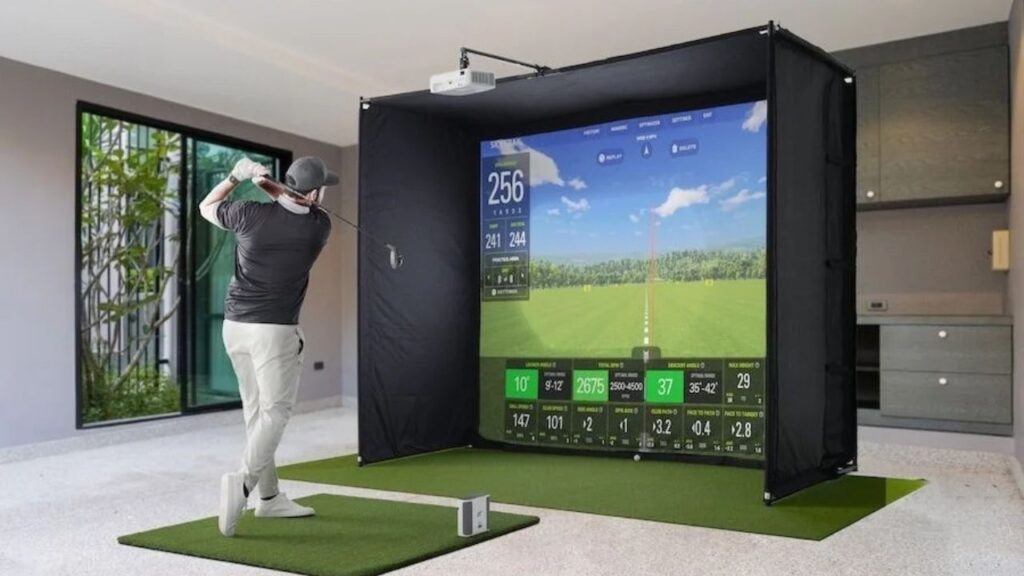
Equipment lease, space lease, or bay time membership?
An equipment lease covers the launch monitor, screen, and enclosure only, so the room and electrical work stay your problem. A space lease covers the building, and every screen and mat inside it is still unpaid. Membership at a local facility is prepaid bay time, not a lease, since you never take possession.
| Deal | What you’re paying for | What you own at term end |
|---|---|---|
| Equipment lease | Launch monitor, screen, enclosure | Depends on lease type (see below) |
| Space lease | The building or suite | Nothing, unless you built in a purchase option |
| Bay membership | Hourly or monthly access | Nothing, ever |
Why “lease” and “finance” get blurred at checkout
One checkout page can offer three products under a single “flexible payment” banner. Bread Pay starts at 0% APR for 12 months, straight financing. Affirm quotes 0% or 10 to 30% APR, also financing. Katapult lease to own approves up to $3,500 and reports payments to credit bureaus, a genuine lease with real default consequences.
Which deal you are in changes every number below
Home hobbyists should read the next two sections closely. Operators need the sections after that instead, since tax treatment and clauses don’t overlap.
The Money Math Nobody Puts on the Page
No, leasing isn’t cheaper than buying with cash. It buys cash flow relief, not savings.
Is an indoor golf simulator lease cheaper than buying?
Run a $12,000 build three ways. Cash costs $12,000. A 24 month 0% financing plan still costs $12,000, spread into $500 monthly payments. A lease on the same hardware runs higher once fees and any residual buyout get added, and the crossover point often lands well before the term ends.
Compare the cost of buying outright against any lease quote line by line first.
The recurring costs a monthly payment never covers
A lease payment covers hardware, not what keeps it useful. The Bushnell Launch Pro, which runs Foresight Sports’ photometric engine under the Revelyst Precision Sports Technology platform, needs FSX Gold at $499 a year before GSPro access, priced at $250 a year, will connect. Silver runs $199 for buyers who skip GSPro. Screens wear, mats compress, bulbs burn down, and none of it appears on the lease schedule.
What business lease brokers claim, and what to verify
Rex Reservations claims leasing cuts upfront capital by 40 to 50 percent, true only because it compares a deposit to a cash purchase, not the five year total. TruGolf publishes real lease terms at 24 to 60 months worth checking against that claim.
The number to ask every lease rep for
Request three numbers on every call: total payments across the term, the residual or buyout amount, and any documentation fee. A rep who answers only in the monthly figure just told you everything without saying it.
Inside the Paperwork: Buyout, FMV, Rent to Own
Three lease structures dominate this niche. A dollar buyout hands you the equipment. An FMV lease usually takes it back. Consumer lease to own sits between and costs the most.
| Structure | Tax treatment | End of term |
|---|---|---|
| $1 buyout / EFA | Treated as a purchase | You own it for $1 |
| FMV lease | Treated as an operating expense | Return, renew, or buy at market price |
| Consumer lease to own | Reported to credit bureaus | Ownership after full term paid |
The dollar buyout lease that acts like a loan
A dollar buyout lease transfers ownership for one dollar the moment the final payment clears. It’s treated as a purchase, so depreciation sits on your books the whole term. Expect a higher payment than an FMV lease on the same hardware, since you’re paying toward ownership, not temporary use.
The FMV lease that ends with an empty room
A fair market value lease returns the equipment at term end unless you buy it at market price, and operators discover this at month 61 when the lessor wants the unit back.
Monthly cost runs lower than a buyout lease, but you own nothing. Checking resale value at lease end matters, since a low buyout only beats what the used unit would fetch anyway. This fits buyers upgrading every few years, not those keeping one unit for a decade.
Consumer lease to own versus true equipment financing
Lease to own approves fast even with weak credit, and it costs the most here because that speed and risk get priced into the rate. Bread Pay plans run 12 to 24 months with no prepayment penalty, making early payoff cheaper. Buyers chasing the lowest cost sometimes skip financing and shop used simulators listed for sale instead, since a well maintained unit can undercut any lease to own total by thousands.
Leasing Gear When You Rent Your Home
Renting your house doesn’t block a build, but it changes what you’re allowed to bolt down before you touch a drill.
What your residential lease says about ceiling anchors
Most residential leases classify enclosure frames and ceiling mounted projectors as alterations, and unauthorized drilling can cost your deposit. A freestanding enclosure or floor mounted screen protects the deposit, since nothing penetrates a ceiling or wall. Get written landlord approval first.
The neighbor with a decibel meter
Iron strikes travel through the floor structure, not the walls, which surprises almost every first time renter. Forum threads document owners hearing complaints even inside concrete buildings, because impact energy transmits through the slab. A floating subfloor or isolation pad under the mat is worth its cost.
Why a lease term should match your simulator commitment
Signing 48 months of equipment payments against a 12 month apartment lease is a mismatch that ends badly. Portable launch monitors and net setups survive a move. Framed enclosures with permanent screens generally don’t, so match the commitment to how long you’ll actually stay.
Signing a Commercial Lease for a Simulator Facility
For an operator, the building lease matters more than the launch monitor brand, since a bad clause can block revenue no launch monitor fixes.
The permitted use clause that quietly bans your leagues
A permitted use clause defines exactly what you’re legally allowed to run in the space, and standard retail wording rarely covers leagues, instruction, events, or food service.
Name every revenue stream explicitly: bay rentals, lessons, leagues, tournaments, retail, alcohol if it applies.
Build out rights, or your landlord picks your contractor
Confirm the right to frame, wire, and hang impact screens with your own crew. One operator lost months of opening timeline to landlord controlled construction. Settle acoustic insulation rights now, since retrofitting after a complaint costs far more.
Restoration clauses that make you rip out your bays
Without a written exception, standard restoration clauses can require tearing bays back to bare walls at lease end. Negotiate language letting improvements stay with the space, sparing you a demolition bill on the way out.
After hours access and the 24/7 membership model
Standard commercial leases assume daytime tenancy and can block a facility’s best revenue hours. Confirm the right to install independent access control on the suite entrance. Unmanned 24/7 access is how small facilities keep payroll near zero while generating late night bay revenue.
Measure the Building Before You Sign Anything
The building itself disqualifies more spaces than any budget conversation will.
The ceiling number that kills most retail spaces
Commercial guidance sets 10 feet as the practical floor for ceiling height, with 11 to 12 feet preferred for a full driver swing with margin. Measure at the actual hitting position, under any ductwork, sprinklers, or fixtures, not the tallest point in the room.
Confirm sprinkler clearance with the fire marshal under NFPA 13, since a code violation can halt construction mid build.
How much square footage a bay really eats
Plan for roughly 15 feet of width and 20 feet of depth per bay built for both left and right handed play. A right handed only bay shrinks meaningfully, and one operator converted two bays that way just to fit an undersized suite.
Power capacity is a five figure surprise
A six bay facility can require 200 to 400 amps of three phase power, catching operators off guard since retail spaces rarely arrive with that capacity. Confirm existing capacity before an electrician quotes anything, and put any upgrade cost on the landlord in writing.
Build Out Money and Who Actually Pays It
Build out costs are negotiable in ways most first time tenants never ask about.
Negotiating a tenant improvement allowance
A tenant improvement allowance is landlord contributed cash toward your build out, and it’s routinely left on the table. Longer lease terms tend to unlock larger allowances, a trade worth making.
Tie rent commencement to delivery, not the calendar
Rent should start when the space is delivered ready for build out, not on a fixed date. Construction delays happen constantly, and paying full rent through months of an unopened facility is avoidable.
What operators actually spend per bay
Forum reported builds land around $20,000 to $25,000 per bay installed. One facility valued a full TrackMan bay near $39,000, another quoted $25,000 per additional bay through an in house contractor.
Reading real rent numbers from listed facilities
A 2,016 square foot facility ran $983 monthly month to month. A 2,346 square foot location listed $3,726 monthly. A 2,500 square foot Birmingham facility listed $5,325 monthly through 2028. Retail simulator space commonly prices between $15 and $30 per square foot annually, and all three fall inside that range.
The Tax Question Your CPA Needs to Answer
This informs the conversation with your accountant. It doesn’t replace one.
Section 179 rewards ownership, not renting
The Section 179 deduction rewards buyers, not renters, since you must be treated as the owner for it to apply. For 2026, the maximum Section 179 deduction sits at $2,560,000, phasing out past $4,090,000 in purchases. Equipment placed in service after January 19, 2025 also qualifies for 100% bonus depreciation, stacking with Section 179.
Why a dollar buyout lease usually qualifies and FMV does not
Finance leases and dollar buyout structures are commonly treated as purchases, opening the door to Section 179 and bonus depreciation. A true FMV operating lease generally gives ordinary payment deductions instead, simpler but leaving the larger deduction behind. Interest on a dollar buyout lease stays separately deductible.
Placed in service beats signed paperwork
Signing a lease in December earns nothing on that year’s return when the bay doesn’t open until February. Equipment generally has to be delivered and operating inside the tax year claimed, a timing detail that trips up more operators than the deduction limits themselves.
Insurance, Damage, and Balls That Leave the Bay
A leased simulator doesn’t lower your liability. It usually raises it, since most lease agreements push property and injury liability onto the tenant.
What your lease makes you liable for
Confirm required insurance coverage limits before quoting a policy. Ask whether the landlord requires being named as an additional insured, since that changes which policy you need.
Screen and enclosure ratings worth demanding in writing
Request the published ball speed rating for any impact screen before installation. Confirm UL listing on projectors, PCs, and powered enclosure hardware. Side netting and ceiling protection are containment for a 165 mph mishit, not decoration.
Wear charges on returned equipment
Leased launch monitors come back for inspection at term end, and screens and mats show real use by then. Photograph every piece at delivery and keep that file for the entire term, your only proof against a wear charge that doesn’t match reality.
Getting Out: Assignment, Fixtures, and Resale Value
Plan the exit while you’re still excited about the entrance. Nobody negotiates well from the middle of a closing business.
The trade fixture clause that saves your hardware
A trade fixture clause designates installed equipment as removable tenant property, not part of the building. Without one, bolted hardware can legally become the landlord’s, covering launch monitors, screens, projectors, and mounts alike.
Assignment rights are what make the business sellable
Push for assignment rights with consent that can’t be unreasonably withheld, since buyers walk away the moment they’d renegotiate a lease from zero. Listed facilities advertising an assumable lease through 2029 or 2030 sell on that line as much as on revenue.
Renewal options with a capped increase
Five years is a common first term for a new operator, so negotiate two renewal options at your own election, each with a capped annual increase. An uncapped renewal clause is how a profitable facility gets priced out of its own building.
Your Last Week Before Signing
Everything above collapses into one final week of verification.
The ten measurements to take with a tape
Measure ceiling height under the lowest obstruction in the exact hitting position, not the highest point in the room. Walk the full swing path of a left handed player in every bay, since a right handed layout blocks half your customer base.
The four documents to have in hand
Get total payments in writing on any equipment lease. Get electrical capacity confirmed by a licensed electrician. Get a real estate attorney to review the lease, and keep an amortization schedule for every financed piece.
The break even model that tells you to walk
One two bay facility listed $4,000 in monthly memberships against $5,700 in expenses, a gap that should stop any operator before signing.
Regional multi bay facilities reported $18,000 to $27,500 in monthly revenue at healthier utilization. Model bays at 30 percent utilization and let that number decide.
Conclusion
You came looking for a monthly payment that made the dream affordable. You’re leaving knowing which lease structure ends in ownership, which clause protects a $25,000 bay, and which number to demand before you sign. Take a tape measure to the ceiling tonight, at the spot you’d actually hit from, and write that number down before you write a check.
A range membership expires every year without a trace. A lease you understood on day one hands you either equipment or a business, and both outlast the season.
Frequently Asked Questions
Can you actually lease an indoor golf simulator for a home, or is that just financing?
Mostly it’s financing wearing a lease label. Home checkout pages labeled “lease” are usually 0% BNPL plans like Bread Pay or Affirm, while true lease to own products like Katapult report to credit bureaus and cost more overall.
What is the difference between an FMV lease and a $1 buyout lease for simulator equipment?
An FMV lease returns the equipment unless you buy it at market price, while a $1 buyout lease hands you ownership for a dollar at the final payment. Buyout leases run higher payments in exchange for guaranteed ownership.
Does a golf simulator qualify for the Section 179 deduction?
Yes, when you’re treated as the owner and the equipment is placed in service within the tax year. A dollar buyout or finance lease typically qualifies. A true FMV operating lease usually doesn’t, since you never take ownership.
How much is the monthly payment on a $15,000 golf simulator?
It depends on the structure and term, not just the price. A 24 month 0% financing plan runs about $625 a month, while a lease with fees and a residual buyout lands higher over the same span.
What does a commercial golf simulator lease cost per bay?
Build out alone runs $20,000 to $25,000 per bay before rent, based on real operator reports, with a full TrackMan bay reaching closer to $39,000 in one documented case.
Do my software subscriptions and course licenses transfer when the lease ends?
No, they stay with the original registrant, not the returned hardware. Course licenses and accounts like GSPro or FSX Gold are tied to the buyer, and any transfer typically requires a separate fee the lessor never mentions upfront.
Is leasing a golf simulator cheaper than buying it outright over five years?
No, leasing is almost always more expensive across five years once fees and any buyout are counted. Leasing solves a cash flow problem today, not a total cost problem, and the two get confused constantly.
2 thoughts on “Indoor Golf Simulator Lease: Complete Cost Guide”