A luxury indoor golf simulator isn’t the $13,995 launch monitor on the spec sheet. It’s the room around it, and most buyers price the box before they’ve measured the space that decides whether the box ever performs. Retailers quote hardware. Nobody quotes the ceiling height, the tee-to-screen depth, or the subscription that renews every January.
That changes here. You’ll see how this build stacks up against the strongest indoor simulator builds, which monitors measure data instead of guessing, and the five-year number that turns a $35,000 sticker into a much bigger number.
Luxury Indoor Golf Simulator
A luxury indoor golf simulator is a permanently installed bay built around tour-level tracking, a purpose-framed room, and finished millwork, not a garage net and a budget radar unit. Full installs run $29,715 to $56,240. Buyers with a dedicated room and daily play habits get the most from one. Weekend hitters rarely need it.What Luxury Actually Buys You In A Sim Room
Luxury buys a room engineered around the swing, not a bigger number on the spec sheet. The sensor reading your ball flight costs the same $13,995 to $21,495 whether it sits in a $25,000 build or a $60,000 one.
The Gap Between A $20,000 And $60,000 Build
The extra $25,000 to $40,000 rarely buys a better sensor. It buys the room. TrackMan, the Danish company whose radar tracking grew out of military targeting research, prices its iO hardware at $13,995 with a year of software bundled in. A full TrackMan 4 room runs $35,000 to $55,000 once framing, enclosure, screen, turf, and labor hit the invoice.
| Build tier | Launch monitor | Room build | Labor | Software (yr 1) | Rough total |
|---|---|---|---|---|---|
| Entry ceiling-mount | $13,995 (TrackMan iO) | $13,745 | Included | Bundled | $29,715 |
| Full designed room | $13,995 to $21,495 | $20,000 to $30,000 | $3,000 to $8,000 | Bundled | $35,740 to $56,240 |
Where More Money Stops Improving Your Ball Data
Ball data plateaus fast. A $13,995 TrackMan iO in a $30,000 room reads the same spin rate as the identical unit in a $56,000 one. The added spend changes acoustic damping and screen tension, not accuracy.
Chasing a bigger number past that point? You’re paying for millwork, not milliseconds.
The Three Things Guests Notice In Ten Seconds
Guests notice screen size, image brightness, and how the mat feels underfoot, and none of those three live on the spec sheet. A first-time hitter doesn’t know a smash factor from a spin axis. They know whether the turf feels like a fairway or a gym mat.
The Room Comes First, Not The Launch Monitor
The room’s ceiling height, depth, and width decide which launch monitor you can run, and that math has to happen before you pick a brand. Buyers who shop hardware first find their dream unit needs three more feet than the basement has.
Is 9 Feet 6 Really Enough For Driver?
Nine feet six inches of finished ceiling clears most driver swings, but it’s tighter than it sounds once framing and duct work eat into it. One owner on the golfsimulatorforum community measured a 9-foot basement bay that finished out at 8 feet 6 inches after drywall, and flattened his swing plane to avoid the ceiling. Purpose-built rooms get framed to 10 feet 6 inches for clean clearance.
Depth Math For A Ceiling Mounted Bay
Tee-to-screen depth eliminates the most launch monitor options before budget enters the conversation. TrackMan iO needs 8 feet 2 inches minimum, 10 feet recommended, and a full overhead build functions from roughly 15 feet of total depth. Uneekor, a Korean manufacturer built around photometric camera arrays instead of radar, ships overhead systems including the EYE XO2 that want closer to 16 to 17 feet.
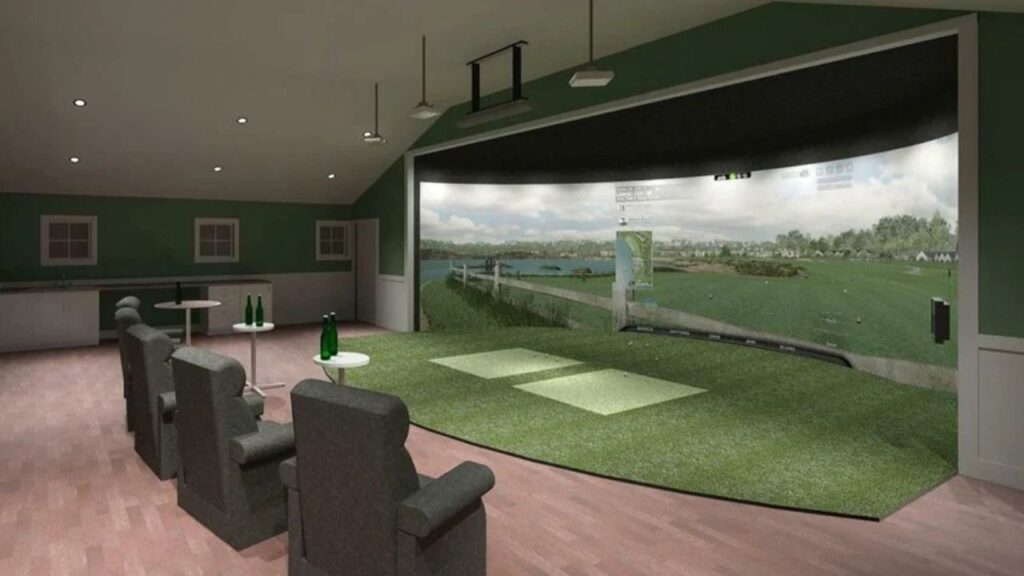
GOLFZON, the South Korean company behind one of the largest screen-golf venue networks in Asia, prices its residential TwoVisionNX systems from $21,300, with a published minimum room of 14 feet 4 inches wide, 18 feet 4 inches long, and 10 feet 8 inches high, a ceiling that rules out most finished basements before the design conversation starts.
Width, Dual Dexterity, And Sharing The Bay
A single-handed width number doesn’t account for a two-golfer household. One right-handed owner built his bay for himself, only to find his left-handed son couldn’t set up a stance without moving the mount. TrackMan recommends 15 feet of width to support both tee positions from one overhead mount.
The Wiring You Cannot Add After Drywall
Rough in electrical and cabling before the walls close, because retrofitting either one after finish work means cutting into a room you just paid to complete. Run a dedicated 20-amp circuit for the electronics, separate from room lighting, and conduit for HDMI from the ceiling mount to the PC. Hidden cable runs top the regret list across owner build threads.
Tour Level Launch Monitors Worth The Money
TrackMan iO, Uneekor’s EYE XO2, and the camera-based systems from Foresight Sports sit at the top of the tour-level tier because each measures real club and ball data with cameras or radar, instead of estimating it from limited inputs.
Foresight, acquired by Vista Outdoor in 2021 and now owned by the private equity firm Strategic Value Partners after Revelyst’s 2025 sale, builds its lineup around cameras rather than radar. This is where tour-grade simulator hardware separates from the consumer tier most retailer blogs push.
| Unit | Tracking method | Room depth needed | Subscription |
|---|---|---|---|
| TrackMan iO | Dual radar and infrared cameras | 15 ft overhead | $700 to $1,100/yr |
| Foresight GCHawk | Quadrascopic camera, infrared | 16 ft, mounted 114 to 126 in high | Varies by package |
| Uneekor EYE XO2 | Photometric camera array | 16 to 17 ft overhead | Pro Package required for GSPro |
Measured Spin Versus Calculated Spin Indoors
Measured spin comes from a sensor reading the ball’s rotation at impact. Calculated spin gets inferred from other data points, and the two are not interchangeable. TrackMan iO measures 3D spin and spin axis directly rather than deriving it from club delivery data.
A peer-reviewed study in the Journal of Sports Sciences tested TrackMan 4 indoors and found spin rate posted the poorest reliability of every metric assessed, with significant session-to-session differences in spin rate, smash factor, and dynamic loft. No ranking result for this keyword cites independent testing that separates repeatability from accuracy.
TrackMan iO At $13,995 And What It Skips
TrackMan iO’s dual cameras run up to 4,600 frames per second alongside radar and infrared, and the unit needs no marked balls or club stickers. The catch: it doesn’t connect to GSPro or E6 Connect, only TrackMan Performance Studio. Home Solution runs $700 a year, Home Complete runs $1,100. See Trackman pricing in detail for the full build breakdown.
Foresight GCHawk And The Camera Approach
Foresight builds the GCHawk around a quadrascopic camera system with integrated infrared, mounted 114 to 126 inches above the ball. The unit weighs 36 pounds, so ceiling structure needs checking before you order one. Its hitting zone measures 52 by 30 inches, wide enough to forgive sloppy tee placement.
Ceiling Mounted Or Floor Unit In A Finished Room
Overhead units mount to the ceiling and stay out of the golfer’s way entirely. Floor units sit between tee and screen, closer to a lamp you walk around than a recessed light you forget is there.
Why Overhead Units Win In Designed Rooms
Overhead mounting removes the box between golfer and screen, and that’s what makes a room photograph like a finished space instead of a garage with equipment in it. One walnut-paneled build has nothing sitting on the floor at all, and left- and right-handed players rotate through the same tee position without touching the hardware.
What You Give Up Going Overhead
Overhead mounting costs you portability entirely, and once installed, your ceiling commitment is permanent. TrackMan iO has to sit 3 feet 3 inches to 3 feet 5 inches in front of the tee. Uneekor’s overhead units mount roughly 3 feet 6 inches behind the tee instead, the opposite direction, and mount, projector, and enclosure baffles all compete for the same few feet of ceiling.
Projectors And The Image You Actually See
The projector decides whether guests see a sharp fairway or a washed-out blur. Throw ratio, ANSI lumens, and mount position are the three numbers that separate a luxury image from an expensive one.
Throw Ratio In Plain English
Throw ratio is the lens distance to the screen divided by the resulting image width, the same math that decides how far back you’d stand a flashlight to light a whole wall instead of a circle on it. BenQ, the Taiwanese projector manufacturer, builds the LH820ST around a 0.497 throw ratio for tight ceiling runs, throwing a 177-inch wide image from about 7 feet away.
Brightness Numbers Retailers Round Up
ANSI lumens measure brightness under a standardized industry test, while marketing lumens on a retail box measure nothing standardized at all.
The LH820ST publishes 3,600 ANSI lumens with a 20,000-hour laser light source, enough to keep fairway texture readable with the room lights on. Ambient light from a window eats brightness faster than most buyers expect.
The Shadow Zone Above Your Head
Every overhead-mounted room has a shadow zone where the golfer’s own body blocks the beam at address, and mapping that path before drilling the ceiling is the difference between a finished room and a redo. Confirm the projector clears the launch monitor mount and any enclosure baffles sharing that ceiling space.
Impact Screens, Enclosures, And Ball Speed Safety
An impact screen rated below your fastest driver swing isn’t a finish problem, it’s a safety problem, and every build needs a published ball speed tolerance in writing before purchase.
Screen Ratings And What 200 mph Means
Elite Screens, the projection screen manufacturer, rates its ImpactWhite 1145 material to golf ball speeds up to 200 mph, well above what any human swing produces. Never accept a screen with no published rating in a room where a driver swing happens six nights a week.
Why Premium Rooms Bury The Frame
Custom fabrication hides the enclosure frame inside the wall assembly entirely, and that single choice is the biggest visual difference between a kit and a designed room. The trade-off: burying the frame removes your ability to reconfigure the bay later without opening the wall back up.
The Noise Your Family Will Complain About
Ball strike, screen slap, and projector fan noise stack into one acoustic signature that travels through floor joists more easily than through walls. Acoustic treatment and floor isolation belong in the build budget from day one, not after the first complaint.
Turf, Mats, And What Your Wrists Feel
The hitting mat decides whether a luxury room gets used every night in February or sits untouched by March, and it’s the cheapest line item most buyers rush through.
Why Cheap Mats End Luxury Rooms Early
A thin mat with no shock-absorbing base produces joint pain in the lead wrist before it produces a missed swing thought. One owner stopped using his build entirely within a season, not because of the data, but because his wrist hurt after every session. Ask any vendor for published shock absorption data.
Recessed Turf And The Level Calibration Rule
TrackMan requires the hitting turf sit level at calibration, or the launch angle reading skews from that point forward. TrackMan iO also needs green turf measuring at least 6 feet deep by 5 feet wide around the tee. Recessing the mat flush with the floor is a framing decision made before the subfloor goes down.
Putting Surfaces Inside The Same Bay
A built-in putting surface adds a real feature, but it also eats depth the golf swing needs. Say clearly when a separate putting green outside the bay serves the room better than cramming one in.
Software, Subscriptions, And The Bill After Year One
The launch monitor price almost never includes what it costs to keep playing past year one, and that renewal is the most under-budgeted line item in a luxury build. A headline price can exclude the full course library, and one ecosystem charges yearly for third-party access while another carries no recurring fee at all.
| Platform | Entry price | Annual renewal | Hardware compatibility |
|---|---|---|---|
| GSPro | $250/yr or $600 lifetime bundle | $250/yr | SkyTrak+, Uneekor, FlightScope, Rapsodo, Foresight |
| E6 Connect (FSX) | $2,500 engine | $300 to $600 | Foresight and Bushnell units |
| TrackMan Performance Studio | Bundled with hardware | $700 to $1,100 | TrackMan hardware only |
Closed Ecosystems Versus GSPro And E6
GSPro delivers the most respected physics engine and course library of any third-party platform, running $250 a year or $600 for a lifetime bundle, but it connects only to open hardware. Foresight’s FSX Play users run E6 Connect, the software that bridges Foresight and Bushnell units into course play, at a $2,500 engine cost plus $300 to $600 a year.
TrackMan iO plays only inside TrackMan Performance Studio, with no path to GSPro or E6 at all.
The Renewal Nobody Budgets For
Year one software gets bundled into the hardware price, which is exactly why buyers forget the bill arrives again twelve months later. TrackMan Home Complete renews at $1,100 every year the room stays in use, a five-figure number over a decade most buyers never see coming.
Course Libraries You Will Actually Replay
A bigger course count is a marketing number, not a usage number, and most golfers replay a small rotation of favorites. TrackMan’s Home Solution tier opens 60 courses, Home Complete opens 270. Foresight owners need a valid FSX Play or FSX 2020 license before GSPro even runs.
The Build Costs Nobody Puts On The Quote
A design-build quote covers hardware, framing, and finish, and almost nothing else, leaving electrical, HVAC, and acoustic work to land as change orders after the contract’s signed.
What Does A Luxury Indoor Golf Simulator Cost?
A complete TrackMan iO home build lands roughly $25,000 to $35,000 fully installed. A full TrackMan 4 room runs $35,000 to $55,000 and beyond, with hardware alone listing at $21,495. Commercial-grade installs commonly quote at $50,000 to $100,000 or more.
TrackMan’s own published breakdown puts a complete Flex Cage build, including the $13,995 iO unit, a $4,500 projector, a $2,995 PC, a $9,000 enclosure, a $2,300 screen and backing, and $1,750 in turf and subfloor, at roughly $35,740, with full packages ranging from $29,715 up to $56,240 depending on enclosure size. See TrackMan’s full home simulator breakdown.
Electrical, HVAC, And Acoustic Line Items
Panel capacity, dedicated circuits, and conduit runs get quoted before any simulator hardware arrives, and skipping this step is how a finished room ends up with an extension cord across the floor. Every one of these items gets quoted by an electrician or HVAC contractor, not the simulator vendor.
The Five Year Number, Not The Sticker
The real cost of ownership stacks hardware, annual software, screen and mat replacement, projector light-source life, and a PC upgrade over five years, and no ranking result for this keyword publishes that stacked number. A $35,740 TrackMan iO room, $700 to $1,100 a year in software, and $500 to $1,000 in consumables pushes the five-year total well past $40,000.
Turnkey Design Firms Versus Building It Yourself
A design-build firm sells a finished room and a single point of accountability. Doing it yourself saves the labor markup but puts every framing, wiring, and calibration decision on your own shoulders.
What A Design Build Contract Should Include
A real design-build contract spells out scaled 3D renderings, custom enclosure fabrication, and a named install crew before a deposit changes hands. Get written confirmation of mount heights, calibration sign-off, and who holds the warranty once the crew leaves.
The Questions That Expose A Thin Vendor
Two questions end a weak sales call fast: the published mounting range and turf requirement for the exact unit they’re quoting, and what happens to calibration when the house settles or humidity swings through a season. A vendor who can’t answer either one is a reseller repeating a spec sheet.
Living With It Season After Season
A luxury room doesn’t stay calibrated forever, and living with one means budgeting for recalibration, consumables, and the small regrets every owner thread eventually surfaces.
Recalibration And Why Your Numbers Drift
Overhead units calibrate to a fixed relationship between mount, tee, and turf, and any change to mat thickness or floor level breaks that relationship. One owner watched his carry numbers shift after a seasonal humidity swing moved his subfloor just enough to throw off the tee position.
Balls, Tees, And Consumables Over A Winter
TrackMan iO reads standard golf balls, which removes a recurring consumable cost some competing systems still carry by requiring marked or specialty balls. Screen wear and mat wear are real line items in a room played four nights a week through an entire winter.
What Owners Say They Would Redo
Ceiling height and hidden cable runs top nearly every regret list posted across owner build threads on Reddit and simulator forums.
Almost nobody regrets the launch monitor they chose. Fix the room first, and the hardware decision gets a lot easier.
Resale, Appraisals, And The Exit Question
No national appraisal dataset supports a fixed dollar value add for a home simulator room, and any contractor who quotes a specific resale premium is guessing, not citing data.
Does A Sim Room Add Home Value?
A luxury sim room does not carry a documented, fixed resale premium the way a finished kitchen does. A non-golfing buyer still sees a room they have to undo, not a feature they’re paying extra for. Build the room for how you’ll use it this winter, not for a resale number nobody can prove.
Which Brands Hold Value On Resale
Premium overhead units like TrackMan iO and Foresight’s GCQuad hold resale value better than budget radar boxes, because tour-level buyers keep shopping the used market for exactly those names. Subscription-locked ecosystems change what a second owner inherits, since a used TrackMan unit still needs its own active software plan to run. See how premium bays hold value for the full breakdown.
Conclusion
You came here pricing a launch monitor. You’re leaving with a room spec, and that’s the real decision this purchase turns on. Tonight, measure your finished ceiling height, tee-to-screen depth, and room width, and write all three numbers down before you open another product page.
This is the golf purchase that gets used on a Tuesday in February, when the range is closed and the course is frozen, and it keeps paying every offseason instead of paying out once a round.
Frequently Asked Questions
What separates a luxury indoor golf simulator from an expensive one?
The room, not the price tag. An expensive build can still have a radar unit crammed into a garage with no acoustic treatment. A luxury build pairs tour-level tracking with a purpose-framed room, buried enclosure, and finished millwork that makes the space feel designed, not installed.
How much does a luxury indoor golf simulator cost fully installed?
Budget $29,715 to $56,240 for a fully installed build. TrackMan iO rooms run $29,715 to $35,740 installed. Full TrackMan 4 rooms and commercial-grade installs run $35,000 to $100,000 or more depending on enclosure size and finish.
What ceiling height, width, and room depth does a premium simulator actually need?
Plan for 10 feet 6 inches of ceiling, 15 to 17 feet of depth, and 15 feet of width for a dual-handed setup. TrackMan iO needs a minimum of 8 feet 2 inches tee to screen, and Uneekor’s overhead systems want closer to 17 feet. GOLFZON’s published residential minimum runs even taller, at 10 feet 8 inches.
Which premium launch monitors gate club data or third-party software behind an annual subscription?
TrackMan iO locks its software behind a $700 to $1,100 annual renewal. Uneekor owners need an active Pro Package subscription to run GSPro. Foresight’s ecosystem varies by package, and none of the three let you skip the renewal question entirely.
Will the rest of the house hear a driver hitting the screen?
Yes, unless the build budgets for acoustic treatment and floor isolation. Ball strike, screen slap, and projector fan noise travel through floor joists more easily than through walls, so a bay built above a bedroom needs decoupling in the plan, not as an afterthought.
2 thoughts on “Luxury Indoor Golf Simulator: Complete Build & Cost Guide”